
From trained model to reviewed prediction.
MLsuite turns a trained model into a form people can use. Upload an .mlbundle, shape its inputs and reports into a versioned schema, run single or bulk predictions, ask colleagues to review the results and export inputs, outputs and answers as one CSV.
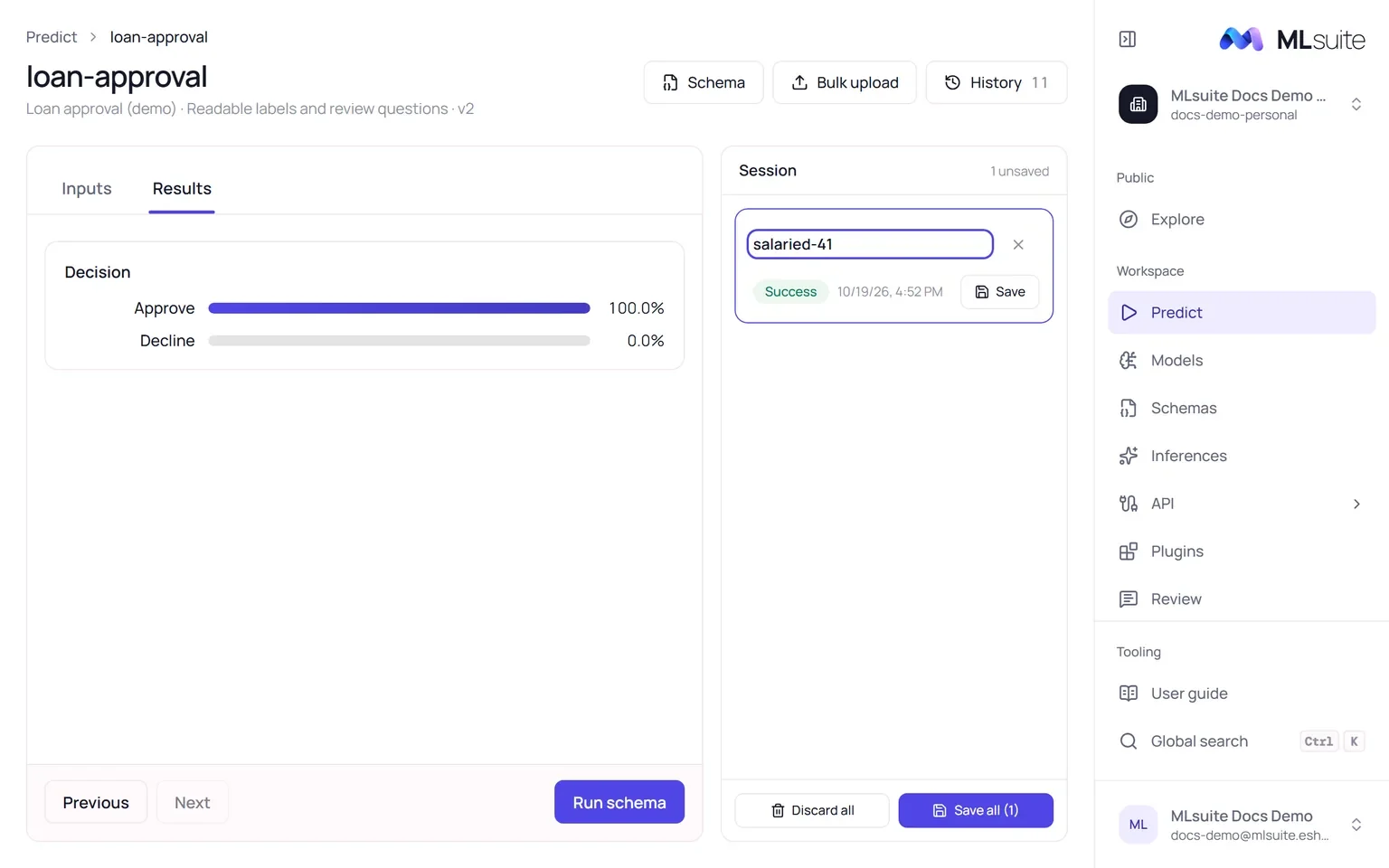
This is the manual for MLsuite, an open-source platform for running machine-learning models through generated forms and collecting human feedback on their results. It covers every option of the web application, the client API that outside software calls, and how to run your own instance. The screens come from the public instance at mlsuite.irlab.org, where anyone can create an account and try it.
Find your path
Section titled “Find your path”Make a first predictionUpload a bundle, create a schema, bookmark it and run it.Shape the formLabels, field kinds, layout and review questions in the schema JSON.Collect feedbackAssign inferences to reviewers and read their answers.Get the data outOne CSV with inputs, outputs and every reviewer’s answers.Share a model publiclyA public page anyone can run, with examples and a publication note.Call it from softwareAPI clients,
mls_ keys and the prediction endpoint.How it fits together
Section titled “How it fits together”MLsuite keeps the whole loop in one place, and keeps every result tied to what produced it:
| Step | Where | What is kept |
|---|---|---|
| Upload a trained model | Models | The .mlbundle file, its SHA-256 and what the bundle says about the model. |
| Describe its inputs and outputs | Schemas | Immutable, numbered snapshots of the form and its model bindings. |
| Run it | Predict | Each saved run, with its inputs, every model’s result and the exact snapshot. |
| Review the results | Review | Each reviewer’s answers, per inference and per report. |
| Use the data | Inferences and export | A filterable table and a CSV of everything above. |
Models come from MLbundle, which packages scikit-learn, XGBoost, CatBoost and ONNX models without pickle. Forms are drawn by MLform. Both are part of eshkra, like MLsuite. MLsuite is MIT licensed; read the source on GitHub.